
Wednesday, December 23, 2009


What did they expect?
This morning on MSNBC on Morning Joe, a group of pundits were going on and on about how terrible it was that the health care bill turned out to be one big payoff to the health insurance industry and big pharma.
But what did they expect? There is a direct correlation between size of government and corruption. As the government gets bigger and more intrusive, it becomes a much better investment for companies and industry to spend money lobbying and bribing politicians than it does to invest in other productive activities, like developing new and better products or providing better value to customers.
One of the pundits was Carl Bernstein, and he was arguing that the only solution was public financing of political campaigns. But who would then decide who gets that public financing, and how exactly will that process not get corrupted?
The best, and perhaps only way to reduce corruption and the influence of money in politics is to shrink the size of government.
But what did they expect? There is a direct correlation between size of government and corruption. As the government gets bigger and more intrusive, it becomes a much better investment for companies and industry to spend money lobbying and bribing politicians than it does to invest in other productive activities, like developing new and better products or providing better value to customers.
One of the pundits was Carl Bernstein, and he was arguing that the only solution was public financing of political campaigns. But who would then decide who gets that public financing, and how exactly will that process not get corrupted?
The best, and perhaps only way to reduce corruption and the influence of money in politics is to shrink the size of government.
Tuesday, December 22, 2009
Blamer-in-chief's disapproval rating climbs to 46%
Wow, even I am surprised.

Of course, Obama continued his blame-a-thon yesterday, blaming the Bush administration for the budget outlook. That was after last week's radio address, where he blamed the economic crisis entirely on the private sector.
President Bush inherited an awful economy, as well as an Afghanistan that was in such bad shape that it was being used by Al Qaeda as a base from which to launch terrorist attacks against the US. Despite these challenges, I don't recall him whining for 11 months about what a mess he was left with.
And President Obama is launching all of these attacks knowing full well that President Bush will not respond or defend himself. What leadership!
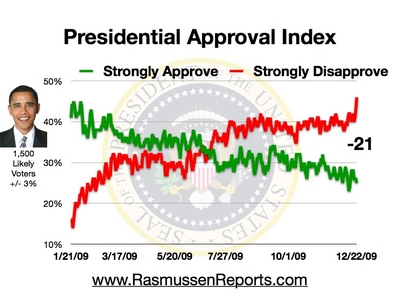
Of course, Obama continued his blame-a-thon yesterday, blaming the Bush administration for the budget outlook. That was after last week's radio address, where he blamed the economic crisis entirely on the private sector.
President Bush inherited an awful economy, as well as an Afghanistan that was in such bad shape that it was being used by Al Qaeda as a base from which to launch terrorist attacks against the US. Despite these challenges, I don't recall him whining for 11 months about what a mess he was left with.
And President Obama is launching all of these attacks knowing full well that President Bush will not respond or defend himself. What leadership!
Monday, December 21, 2009
Medicare denial rates higher than private insurer's
One argument often cited in support of single payer health care or the need for a public option is the idea that health insurance companies have an incentive to reject legitimate claims because they are motivated by profit. I find that argument similar to saying that because WalMart is motivated by profit, that it has an incentive to not honor its return policy, or that Apple has an incentive to not honor IPOD warranties, or that McDonalds has an incentive to serve its customers spoiled food because it might save them a few bucks. The reason that this is not necessarily true is because profit motivated companies have an incentive to protect their reputations, and health care insurance companies are for the most part, no different.
And if the proponents of government health care are correct, then why, according to the AMA's National Health Insurer Report Card, does Medicare apparently reject claims at a higher rate than private insurers? And why did Aetna, who rejected 6.5% of its claims in 2008, in 2009 reject only 1.81% of claims in 2009? Did Aetna all of a sudden become less concerned with profits?
And if the proponents of government health care are correct, then why, according to the AMA's National Health Insurer Report Card, does Medicare apparently reject claims at a higher rate than private insurers? And why did Aetna, who rejected 6.5% of its claims in 2008, in 2009 reject only 1.81% of claims in 2009? Did Aetna all of a sudden become less concerned with profits?
Friday, December 18, 2009
Super Genius in Chief pleased to be on the precipice
"From the discussions we had, it's clear that we are on the precipice of an achievement that has eluded Congresses and presidents for decades."
--President Obama, after meeting with Senate Democrats on the health care bill, Dec. 15, 2009.
MIRIAM-WEBSTER DICTIONARY: "1: a very steep or overhanging place; 2: a hazardous situation; broadly : brink"
--Reply by Senate Republican Leader Mitch McConnell's office.
Here's another way to look at it.

Unfortunately, if this bill passes, and it does the damage to health care, the economy, and the federal budget that I expect it will, I doubt the Democrats will ever suffer any consequences, politically. In fact, once it's in place, nationalized healthcare's failures will be taken as signs that we haven't gone far enough, that the federal role must expand even further. Though the smartest politician in the history of the universe may be delighted as he dances over the cliff, it's the rest of us who will take the fall.
"Extraordinary Measures"
Last night I attended a screening of the film Extraordinary Measures starring Harrison Ford, Brendan Fraser, and Keri Russell, set for release on January 22, 2010. It's a remarkable real life story of human action, pursuit of self interest, entrepreneurial skill, scientific ingenuity, and the indispensable role of profit maximizing financiers and corporate executives, and how it all comes together to produce a medical miracle. Yes, the business types were at times portrayed as unlikeable, but missing were the villainous corporations and heroic trial lawyers. And thankfully, government bureaucrats and politicians were no where to be found. See trailer below.
Thursday, December 10, 2009
My Next Congressman?
Below is a video of a remarkable speech made by Congressional Candidate Lt. Col. Allen West that is going viral.
The speech includes some pretty strong rhetoric, including talk of a "producing class vs an entitlement class" and the idea of "taking the country back" and grabbing your "bayonets". I guess he is just another one of those "teabagging rednecks", as Janeane Garofalo likes to say.
I reviewed his website (which could use some work), and it is clear that he is a fairly consistent small government conservative, except for the fact that he is in favor of nationalizing the windstorm insurance market, a proposal also known as "bailouts for beach houses". Given the geography of the district, which hugs the coast from Northern Palm Beach county down into Broward County, I guess he can be forgiven. The other thing that is striking about the website is that it includes an entire section on Israel. Again, being outspokenly pro-Israel is perhaps another pre-requisite for winning this seat. On foreign policy, he is decidedly hawkish, calling for an end to the "PC non-sense" when it comes to fighting the war on terror, while also arguing that "we must get away from occupation warfare and nation building".
He is certainly one to watch.
The speech includes some pretty strong rhetoric, including talk of a "producing class vs an entitlement class" and the idea of "taking the country back" and grabbing your "bayonets". I guess he is just another one of those "teabagging rednecks", as Janeane Garofalo likes to say.
I reviewed his website (which could use some work), and it is clear that he is a fairly consistent small government conservative, except for the fact that he is in favor of nationalizing the windstorm insurance market, a proposal also known as "bailouts for beach houses". Given the geography of the district, which hugs the coast from Northern Palm Beach county down into Broward County, I guess he can be forgiven. The other thing that is striking about the website is that it includes an entire section on Israel. Again, being outspokenly pro-Israel is perhaps another pre-requisite for winning this seat. On foreign policy, he is decidedly hawkish, calling for an end to the "PC non-sense" when it comes to fighting the war on terror, while also arguing that "we must get away from occupation warfare and nation building".
He is certainly one to watch.
Wednesday, December 9, 2009
Joe Barton
The Congressman who sponsored the ridiculous legislation to regulate the BCS national championship made this speech on the floor of the House regarding health care. It is both hilarious and infuriating in light of his NCAA football power grab.
Among his best lines are: "we don't believe in mandates", "we believe in individual choice", "we believe in the American system of free enterprise", and "I vote for more freedom".
If you really believe these things, then why in the world are you meddling in the affairs of the NCAA? I didn't realize Congress had the authority to regulate the use of the term "National Champion". If you don't like it, then exercise some freedom and don't watch it.
Among his best lines are: "we don't believe in mandates", "we believe in individual choice", "we believe in the American system of free enterprise", and "I vote for more freedom".
If you really believe these things, then why in the world are you meddling in the affairs of the NCAA? I didn't realize Congress had the authority to regulate the use of the term "National Champion". If you don't like it, then exercise some freedom and don't watch it.
House Panel: Belichick Should Have Punted
Just kidding. A House Energy and Commerce Committee subcommittee didn't really chastise the Patriot's coach for going for it on 4th and 2 against the Colts.
But they did just approve a bill requiring the NCAA to institute a playoff system to determine the college football champion.
What a bunch of jerks. Why can't these people just do their jobs?
But they did just approve a bill requiring the NCAA to institute a playoff system to determine the college football champion.
What a bunch of jerks. Why can't these people just do their jobs?
Michael Steele on Harry Reid's "slaveowner" comment
Harry Reid recently compared the opponents of the health care takeover to those who opposed the end of slavery and giving women the right to vote:
Michael Steele was asked about Harry Reid's comments this morning on Morning Joe, and he said that Reid is "out of touch" and that the remarks are "unfortunate". Donny Deutsch followed up by asking Steele, "I still don't understand why the analogy that Reid made is wrong? He is just saying that any time we have 'dramatic change', that there is going to be resistance. What is wrong with what he said?"
Steele dodged the question by saying "I am not going to dignify that question with a response". Deutsch then openly mocked him for not being able to provide an answer. The video is below:
Thinking of a bumper sticker I recently saw, this would have been my answer:
Maybe that answer is over the top, but not any more so than Reid's original analogy. In any case, Steele has got to do a better job articulating an opposing point of view.
And by the way, here is that bumper sticker:

When this country belatedly recognized the wrongs of slavery, there were those who dug in their heels and said 'slow down, it's too early, things aren't bad enough.'
Michael Steele was asked about Harry Reid's comments this morning on Morning Joe, and he said that Reid is "out of touch" and that the remarks are "unfortunate". Donny Deutsch followed up by asking Steele, "I still don't understand why the analogy that Reid made is wrong? He is just saying that any time we have 'dramatic change', that there is going to be resistance. What is wrong with what he said?"
Steele dodged the question by saying "I am not going to dignify that question with a response". Deutsch then openly mocked him for not being able to provide an answer. The video is below:
Visit msnbc.com for breaking news, world news, and news about the economy
Thinking of a bumper sticker I recently saw, this would have been my answer:
There was dramatic change in Cuba in 1959, was that good change? And were those who were opposed to that change, those who were "clinging" to the principles of freedom and private property and free markets, were they also just dragging their feet and getting in the way of progress? If you want to talk about progress, why don't we go down to Cuba and see what kind of "progress" you get when the government takes over the economy.
Maybe that answer is over the top, but not any more so than Reid's original analogy. In any case, Steele has got to do a better job articulating an opposing point of view.
And by the way, here is that bumper sticker:

Subscribe to:
Posts (Atom)

 Posts
Posts

